



Sensor Blending Algorithms
To achieve a smooth, accurate, and consistent global 3D field, the 2D information is first blended from a variety of satellite sensors into a set of cohesive global fields that can then be processed into the 3D product. Currently, a variety of blending and stitching methods are being evaluated and developed, including manual hard cutoffs based on sub-satellite distance, weighted averaging techniques based on a variety of static and dynamic factors, and combination averaging/sampling techniques.
- Physically reasonable, avoiding the non-physical situations that can arise from averaging sensor data together.
- Computationally efficient, to serve as one step in a near real-time pipeline.
Goals:
- To create a blended product that satisfies all of the following criteria:
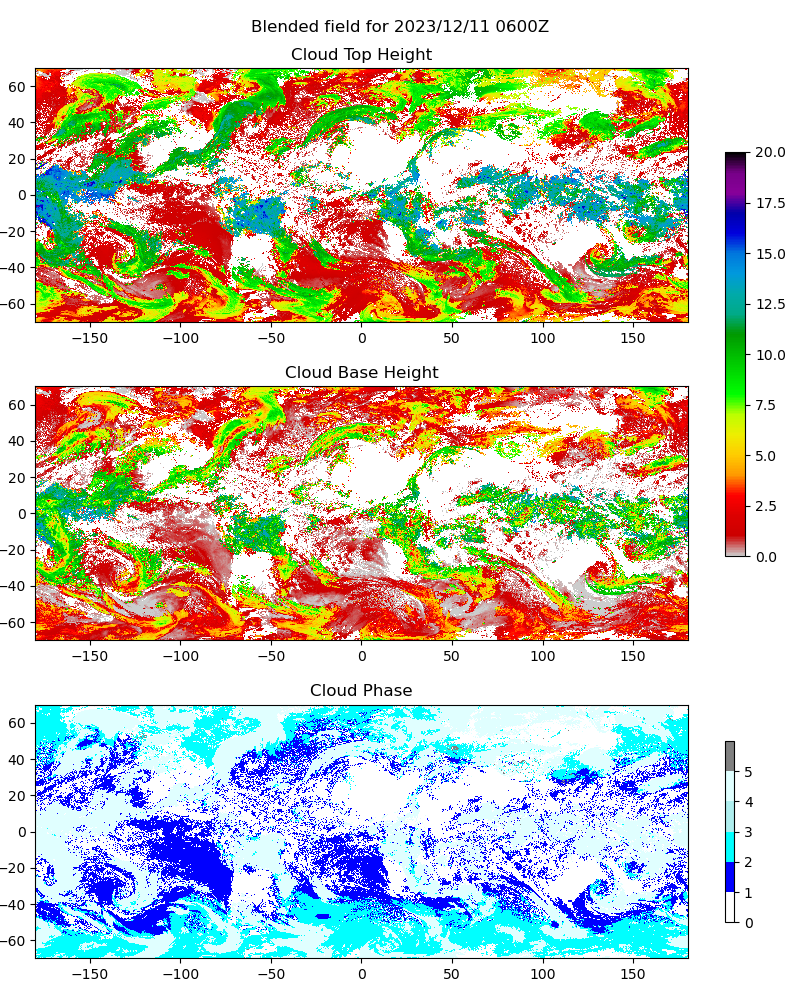
Figure: A global blended composite of cloud top height (CTH), cloud base height (CBH), and cloud phase (CP), using weighted averaging (for CTH and CBH) and weighted selection (for CP) schemes.