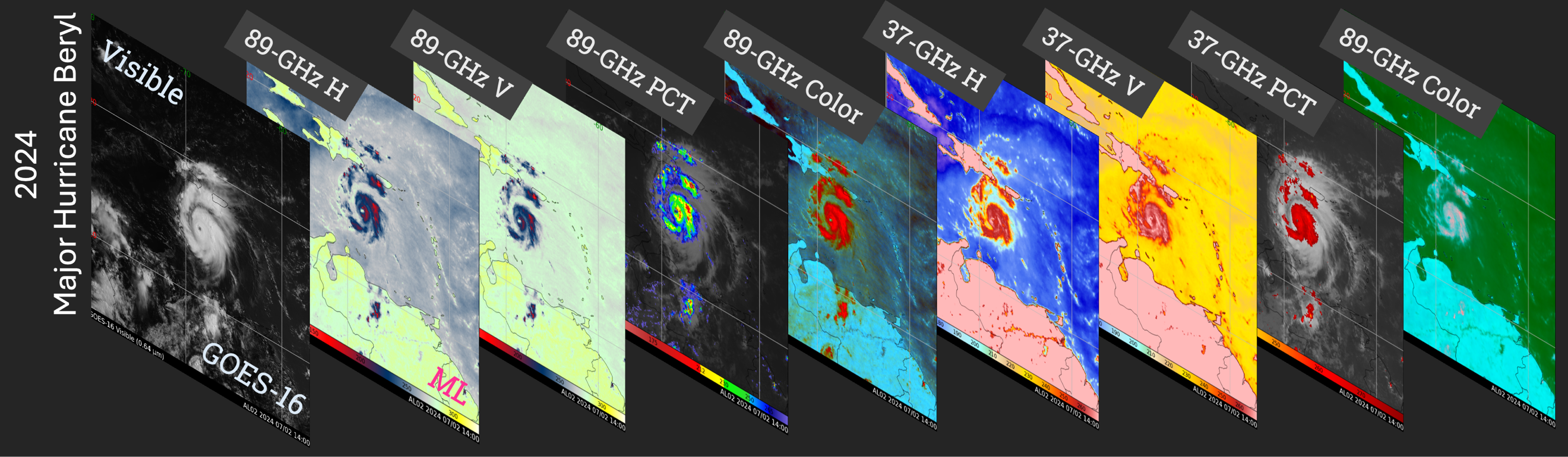
Figure: OVERCAST synthetic passive microwave (SPM) products showing the different wavelengths/polarizations. The left-most panel is visible imagery, and the rest are synthetic (ML) products.




Global Synthetic Passive Microwave (SPM)
Passive microwave imagery displays information regarding deep convection, liquid water, and rainfall, providing a unique perspective of storm structure and organization that is typically obscured by high clouds and cirrus in conventional infrared (IR) and water vapor (WV) imagery. Since passive microwave imagery is only available on polar-orbiting satellites, operational use cases suffer from temporal gaps and spatial inconsistencies. To overcome these limitations, 37 and 89 GHz imagery is being developed from geostationary satellites using machine learning (ML), aiming to deliver global imagery in real time. This information has long been used by tropical cyclone forecasters to monitor tropical cyclones; however, by making this information available globally at high spatial and temporal resolutions, we aim to extend the utility of this imagery to provide storm information for world-wide forecasting and scientific discovery.
To do this, a variety of ML techniques are being used, including random forests (RF), fully-connected neural networks (ANN), convolutional neural networks (CNN) and diffusion models. Currently, four products are being trained: 37 GHz horizontal vertical polarization (V-Pol), 37 GHz vertical polarization (H-Pol), 89 GHz H-Pol, and 89 GHz V-Pol. Initially, the focus is on two key products: 1) 89 GHz horizontal polarization (H-Pol) and 2) 37 GHz color product. The passive microwave imagery centered at 89 GHz provides information regarding deep convection, ice, and liquid water structure. At 89 GHz, microwave signals are scattered by larger ice particles in deep convection (cold signal) and re-emitted by warm rain and clouds (warm signal). The passive microwave imagery centered at 37 GHz provides complimentary information to images of 89 GHz. Because this wavelength is more sensitive to lower-level atmospheric layers, the imagery has the capability to detect low-level circulation centers and rainbands with less parallax error.
Goals:
Figure: OVERCAST synthetic passive microwave (SPM) products showing the different wavelengths/polarizations. The left-most panel is visible imagery, and the rest are synthetic (ML) products.