



Optical Flow
Optical flow is defined as the distribution of velocities of brightness patterns in an image. Advanced schemes made possible by new computing hardware and decades of research by the computer vision community enable accurate “dense” (every image pixel) retrievals of optical flow, which can be used for a myriad of novel downstream products. In satellite imagery, optical flow retrieval is used to quantify cloud and water-vapor drift motions that in turn can be either navigated to infer atmospheric winds (e.g. Atmospheric Motion Vectors) or be used to extrapolate pixel feature motions beyond when they are scanned. In OVERCAST, optical flow retrieval is performed on geostationary imagers (e.g. Figure 1) to A. adjust the locations of pixels between geostationary and low-earth-orbiting imagers to valid times of the global mosaic grid (so-called “Temporal Correction”), and B. to extrapolate cloud products forward in time for rudimentary, computationally efficient nowcasts out to +3 hours (Figure 2).
- To provide optical flow-based temporally corrected cloud products that benefit the overall accuracy of a global 3D cloud mosaic.
- To provide accurate cloud-drift motions needed for advection-based nowcasts of clouds.
Goals:
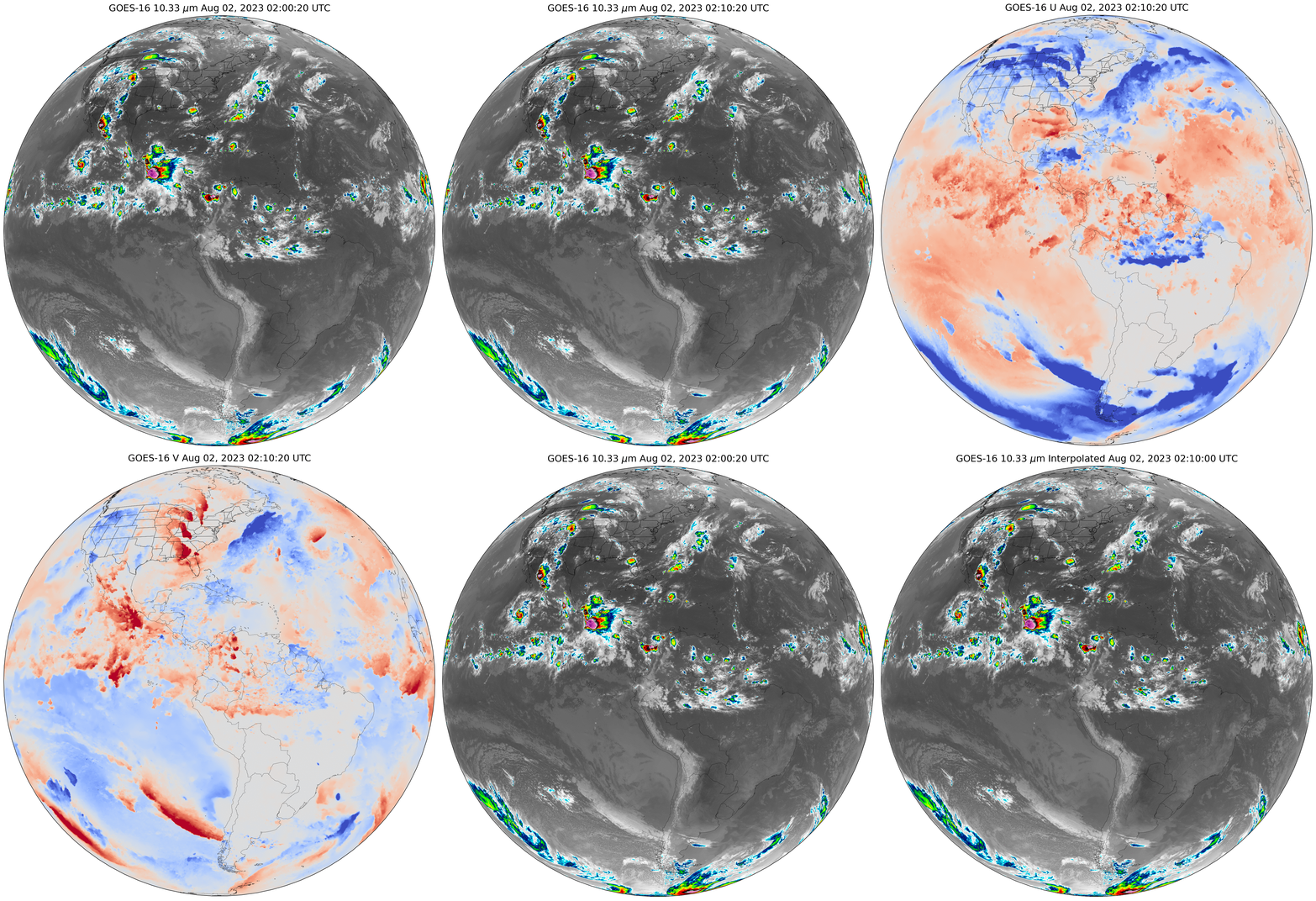
Figure: The loop contains two GOES-16 ABI 10.3 um images with scans that start at 02:00 and 02:10 UTC, followed by their respective optical flow, followed by the 02:00 UTC image again, followed by the 10.3 um image at exactly 02:10 UTC (with the scan-time-motions removed)